


Singapore Grand Prix 2026: Marina Bay Odds in F1's New Regulation Era


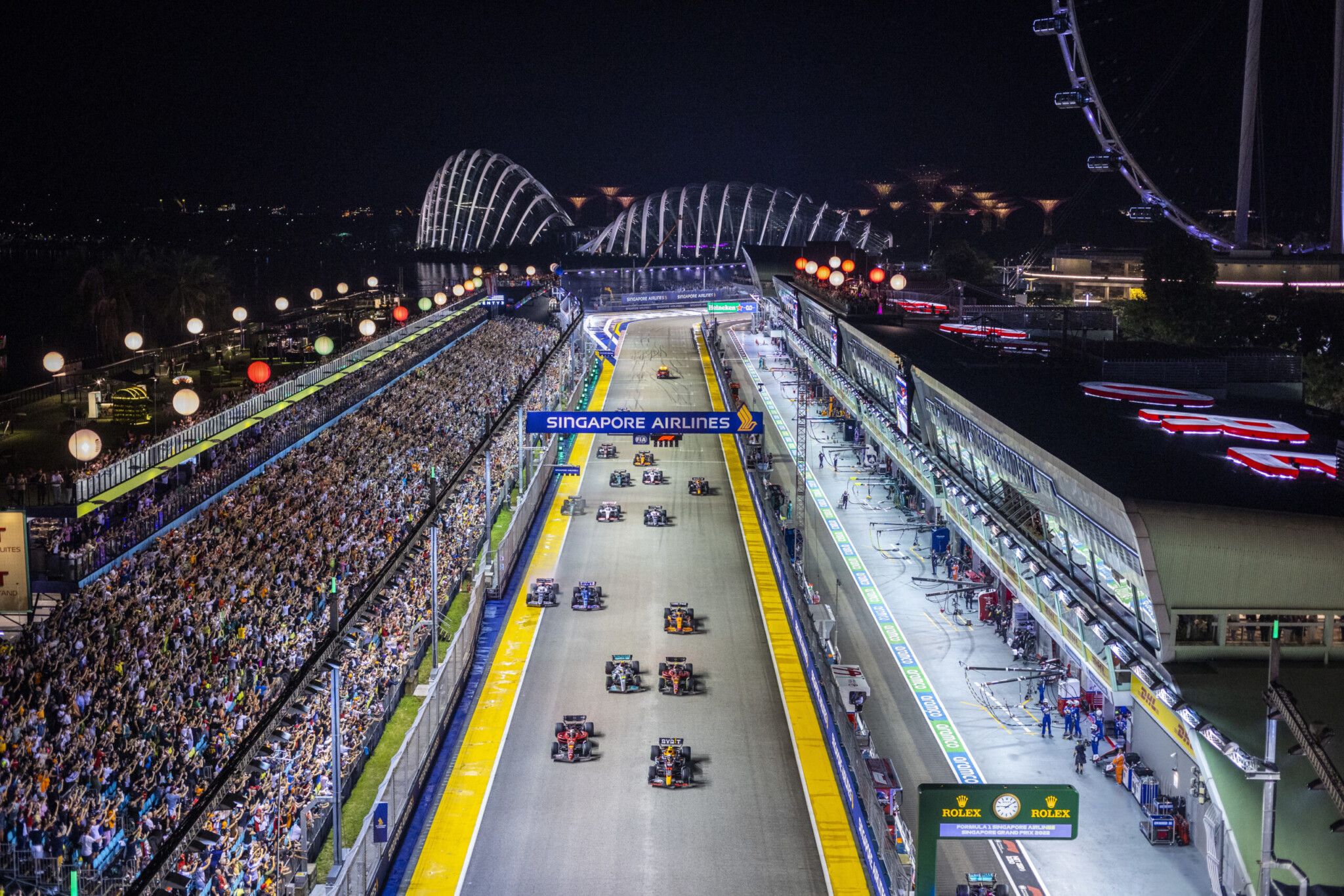
Formula 1's new regulation era faced one of its toughest tests at the 2026 Singapore Grand Prix, and Marina Bay produced a result the season-long form book did not predict. Max Verstappen won from pole position, ahead of Charles Leclerc and championship leader Kimi Antonelli. This guide covers the schedule, why 2026 form is harder to trust, what qualifying, the Safety Car and the Sprint changed, and what the weekend teaches for F1 betting.
When was the 2026 Singapore Grand Prix?
The race weekend ran from October 9-11 at the Marina Bay Street Circuit. It was the first time Singapore hosted a Sprint weekend, which left teams with a single practice session before competitive running began.
| Session | Date | Local time |
|---|---|---|
| Practice 1 | Friday, October 9 | 4:30 p.m. |
| Sprint Qualifying | Friday, October 9 | 8:30 p.m. |
| Sprint | Saturday, October 10 | 5:00 p.m. |
| Grand Prix Qualifying | Saturday, October 10 | 9:00 p.m. |
| Grand Prix | Sunday, October 11 | 8:00 p.m. |
The main race ran for 62 laps around the 4.927-kilometer circuit.
Why is 2026 F1 form harder to trust?
Bettors can normally put significant weight on a team's results across the previous few races. That is still useful in 2026, but the new regulations make circuit characteristics particularly important.
The new power units dramatically increase the electrical contribution, and the MGU-H has been removed. The cars are lighter and use active aerodynamics designed to improve efficiency and racing, and Formula 1 described the combined engine and aerodynamic reset as giving every team a fresh starting point.
Mercedes adapted best overall. Antonelli led the Drivers' Championship after winning eight of the first 14 races, George Russell sat second and Mercedes held a substantial Constructors' lead. Yet Marina Bay emphasizes slow corners, braking, rear grip and traction, and energy deployment matters when drivers repeatedly accelerate out of low-speed sections. A car that shines at a faster circuit may not carry the same advantage here.
Singapore Grand Prix odds
Antonelli entered the weekend among the leading names, with an 81-point championship lead over Russell as of mid-September. Even so, Singapore was a race where practice and Sprint Qualifying revealed more about the true order than the standings did. Verstappen won the Sprint and took pole, then converted it into a lights-to-flag victory, 7.3 seconds clear of Leclerc. Antonelli finished third and stretched his lead to 102 points over Russell, who climbed to ninth from the back of the grid after an engine penalty.
For anyone following Singapore Grand Prix odds, the lesson is simple: a season-long favorite is not automatically the favorite at every circuit.
Why does qualifying matter so much at Marina Bay?
Track position is especially valuable in Singapore. Although changes to the circuit have made passing easier, Pirelli still described overtaking at Marina Bay as "rather complicated" before the 2025 race.
The results back that up. Before 2025, 10 of the previous 15 Singapore Grands Prix had been won from pole position. Russell then started from pole and won, making it 11 wins from 16 races, and Lando Norris had converted pole into victory in 2024. Verstappen added another in 2026, which brings the record to 12 wins from 17 races.
That makes qualifying markets particularly relevant. A driver who looks competitive in outright race odds but struggles over one lap may be a less attractive option here than at a circuit where overtaking is easier. Post-qualifying race odds are also worth reassessing, since a shorter price on a pole-sitter can still beat a longer-priced driver who has to fight through traffic.
How important is the Safety Car in Singapore?
For years the answer was extremely. Every Singapore Grand Prix from the inaugural 2008 race through 2023 featured at least one Safety Car. The streak ended in 2024, when Norris won the first Safety Car-free race in Marina Bay history, and the 2025 race passed without one as well. Race reports indicate the 2026 edition also ran without a full Safety Car, so the old assumption that one is almost guaranteed no longer holds.
The risk is still significant. Marina Bay is a narrow street circuit with walls close to the racing line, and any interruption can transform pit strategy: a driver who pits just before a Safety Car can lose heavily, while another effectively gets a cheaper stop. That makes live betting particularly interesting once pit windows begin, and Safety Car markets deserve more nuance after three races in a row without one.
What does the Sprint format change?
Singapore's Sprint debut reduced preparation time. Teams had only Practice 1 on Friday before Sprint Qualifying, the Sprint followed on Saturday afternoon, and Grand Prix qualifying came that evening.
For bettors that created two effects. First, teams had less time to perfect setups on a completely new generation of cars, so early pace was less reliable than in a normal three-practice weekend. Second, the 21-lap Sprint gave an extra competitive session to evaluate: how a car handles tire temperatures, traffic and energy management says a lot before Grand Prix qualifying. Verstappen's Sprint win was an early sign of the pace he carried into Sunday.
What should you consider before betting on the Singapore GP?
Do not rely on championship position alone. Watch one-lap pace closely, because qualifying has historically carried enormous weight at Marina Bay, and consider how each car performs through the slower corners and traction zones.
Reassess after the Sprint rather than assuming first practice tells the full story. Above all, 2026 is still the first season of a major technical reset, and the strongest car across the championship may not be the strongest at every circuit, as Verstappen's win ahead of the Mercedes pair showed.
Bet on the Singapore Grand Prix with crypto at 1xBit
1xBit offers crypto-first lines for motorsport, with markets such as race winner, qualifying and podium and live betting as the weekend unfolds. Players can deposit and withdraw with Bitcoin and more than 40 other supported cryptocurrencies, with fast payments and competitive odds.
With only one practice session before competitive running, the 2026 Singapore Grand Prix rewarded bettors who waited for Marina Bay-specific evidence rather than simply following season-long form.
FAQ
The weekend ran from October 9-11 at the Marina Bay Street Circuit. The race started on Sunday, October 11, at 8:00 p.m. local time and covered 62 laps.
Max Verstappen won from pole position, 7.3 seconds ahead of Charles Leclerc. Kimi Antonelli finished third.
Overtaking is difficult on the narrow street circuit, and 12 of 17 Singapore Grands Prix have been won from pole. That makes one-lap pace a key factor for both race and qualifying markets.
Every race from 2008 to 2023 had one, but the 2024 and 2025 races did not, and reports indicate 2026 also ran without a full Safety Car. The risk remains real on a narrow circuit with walls close to the track, so it is a market worth pricing with care.
Teams get only one practice session, so early pace is less reliable. The 21-lap Sprint gives an extra competitive session to assess tire management, traffic and energy use before Grand Prix qualifying.
Sergey Ilyin
An experienced specialist in the field of betting and gambling. He analyzes market trends, player behavior, and the dynamics of online gaming platform development. An expert in the intricacies of sports betting and knowledgeable about the regulatory framework of the gambling industry.